Apprenticeship in aerospace: contract rules and employer aid in France
A preferred route for training mechanics, technicians and engineers, apprenticeship follows a precise legal framework. Hiring aid has been revised several times since 2025: an overview of the current rules for manufacturers and maintenance shops.
By Newsroom · Published

A central training route for the industry
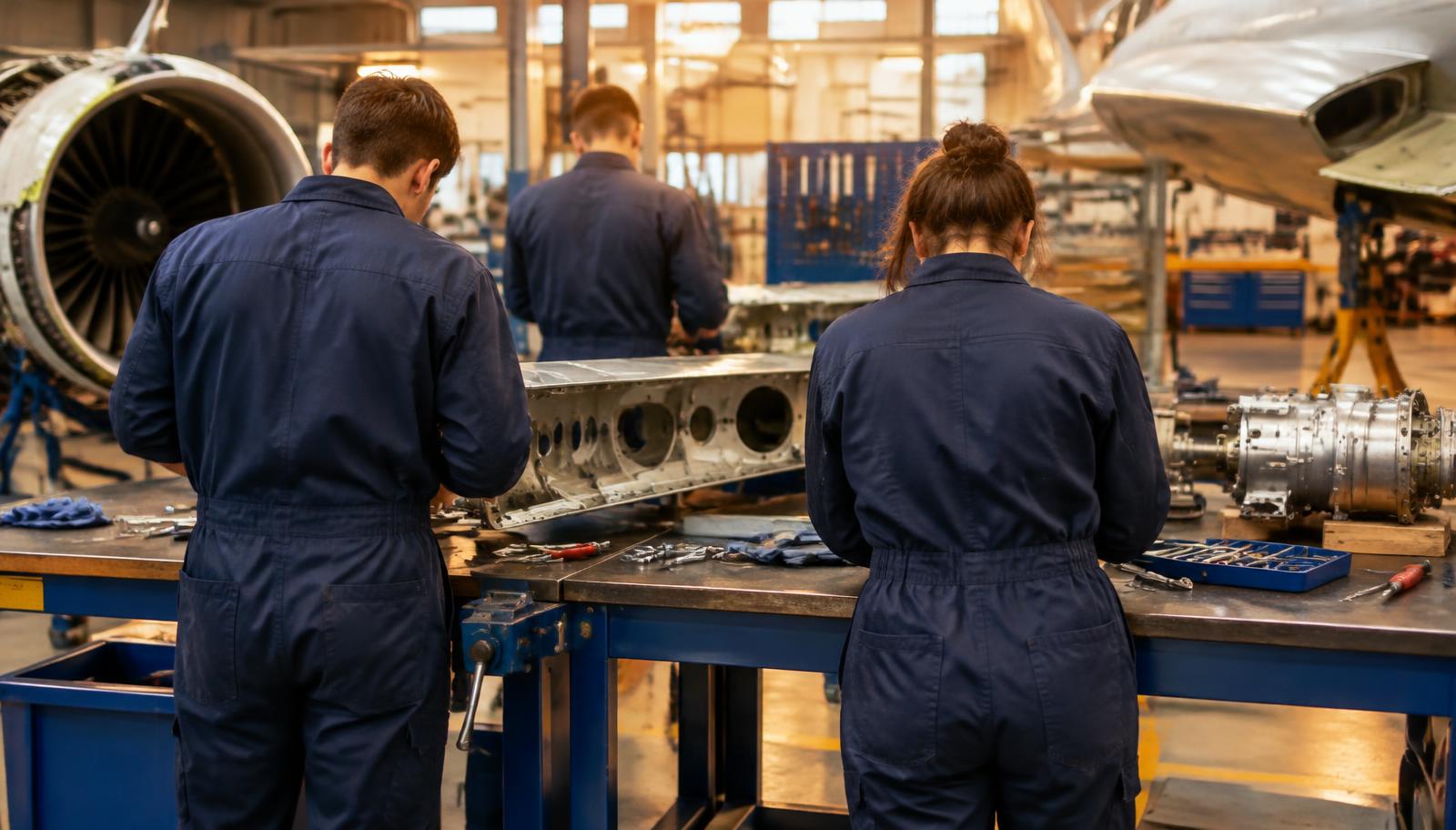
Aerospace makes intensive use of work-study training. The model fits its needs: advanced technical skills, a culture of safety and traceability that is acquired on the job, and qualifications ranging from vocational certificates to engineering degrees. For a manufacturer, maintenance shop or equipment supplier, the apprentice is often the future skilled employee the labour market does not supply.
The rules of the apprenticeship contract
The apprenticeship contract is an employment contract between an employer and a young person following a course at an apprentice training centre (CFA). Its main features, as presented by the official Service-Public.fr portal:
- age: 16 to 29, with exemptions, for example for some 15-year-olds who have completed lower secondary school, and cases where the limit is raised to 35 or removed, notably for recognised disabled workers;
- duration: as a fixed-term contract, from 6 months to 3 years, depending on the training cycle; the contract can also be a permanent one starting with an apprenticeship period;
- early termination: during the first 45 days, consecutive or not, of practical training in the company, either the employer or the apprentice may terminate the contract in writing; after that, termination is only possible in specified cases.
Minimum pay is set as a percentage of the French minimum wage (Smic), according to age and contract year. For example, it ranges from 43% in the first year to 67% in the third for an apprentice aged 18 to 20, and reaches 100% of the Smic from age 26. Collective agreements may set more favourable minimums, which is common in the metalworking sector.
Aid revised in 2025 and 2026
Hiring aid for apprentices has been gradually tightened. According to the official page on entreprendre.service-public.gouv.fr, checked in July 2026, contracts signed since 8 March 2026 qualify, for the first year of the contract only, for the following amounts:
- companies with fewer than 250 employees: €5,000 (single aid) for a qualification up to level 4 (baccalaureate), €4,500 for level 5 (two years of higher education) and €2,000 up to level 7 (master's);
- companies with 250 employees or more: €2,000 up to level 4, €1,500 for level 5 and €750 up to level 7, subject to work-study targets;
- apprentices with a disability: up to €6,000, regardless of company size.
These amounts are pro-rated to the actual contract duration. As the rules have changed several times in a short period, employers should check the official page on the date each contract is signed.
What it means for aerospace
Lower aid for higher levels directly affects work-study engineering and bachelor-level programmes, widely used by the industry's large groups. Conversely, courses at baccalaureate level and below, such as vocational certificates or the aeronautics vocational baccalaureate, remain better supported in SMEs, which make up most of the supply chain.
For shops and manufacturers, a few points deserve attention:
- appoint an available and qualified apprenticeship supervisor, a condition for success as much as for compliance;
- align the work-study calendar with production and safety constraints, particularly for minors;
- plan for integration at the end of the contract, which remains the economic purpose of the investment.
A long-term investment
Beyond the aid, apprenticeship remains a skills-building tool in an industry where training an autonomous technician takes several years. Companies that structure their work-study policy, in conjunction with training centres and the campus des métiers, give themselves the means to secure future recruitment.
Sources
Related articles
Campus des métiers et des qualifications: France's regional networks for aerospace training
Secondary schools, apprentice centres, universities, companies and regions: France's campus des métiers et des qualifications bring together a territory's training players around one industry. Seven are dedicated to aeronautics and space.
Recruitment: the French aerospace industry faces a lasting skills need
With 29,000 hires in 2024 according to GIFAS and more than 230,000 direct jobs, the aerospace industry remains one of France's largest industrial recruiters. Beyond the headline volumes, skills and the supply chain dominate the agenda.
Aerospace engineering schools: a French landscape of public grandes écoles and private institutions
ISAE-SUPAERO, ENAC, IPSA and others: France has a dense network of engineering programmes dedicated to aeronautics and space. Understanding their status, entry routes and the role of the CTI helps candidates and recruiters find their way.