Recruitment: the French aerospace industry faces a lasting skills need
With 29,000 hires in 2024 according to GIFAS and more than 230,000 direct jobs, the aerospace industry remains one of France's largest industrial recruiters. Beyond the headline volumes, skills and the supply chain dominate the agenda.
By Newsroom · Published
High hiring volumes
The French aerospace industry has returned to sustained employment growth. In its New Year press release published in January 2026, GIFAS (the French aerospace industries association) reported that its members made 29,000 hires in 2024, for a total of 222,000 direct jobs and the creation of 14,000 net jobs, a 5% increase in headcount. At the time, the association estimated 2025 hiring at between 25,000 and 30,000.
At its general assembly in July 2026, GIFAS stated that the industry had recruited more than 20,000 people across all regions and directly employed 230,500 people. The profession reports 2025 revenue of €85.6 billion, split 74% civil and 26% defence.
These figures should be read with care: they cover GIFAS members rather than the whole ecosystem, which also includes non-member subcontractors, maintenance shops and services.
A supply chain under strain
The main challenge is no longer just recruiting but sustaining production rates. Major prime contractors have order books stretching over several years, and the supply chain's ability to keep up determines deliveries. According to the annual study carried out with the Banque de France and cited by GIFAS, supply chain headcount is now above its 2019 level, marking the end of the pandemic downturn in that respect.
SMEs and mid-sized firms concentrate a large share of the difficulties. GIFAS notes that the SMEs in its Aéro-PME committee account for 11% of the industry's workforce and 8% of its revenue, and that 44% of their managers are over 60. Business succession therefore adds to the recruitment challenge.
Identified shortage occupations
Needs span a wide range of profiles, from vocational certificates to engineering degrees:
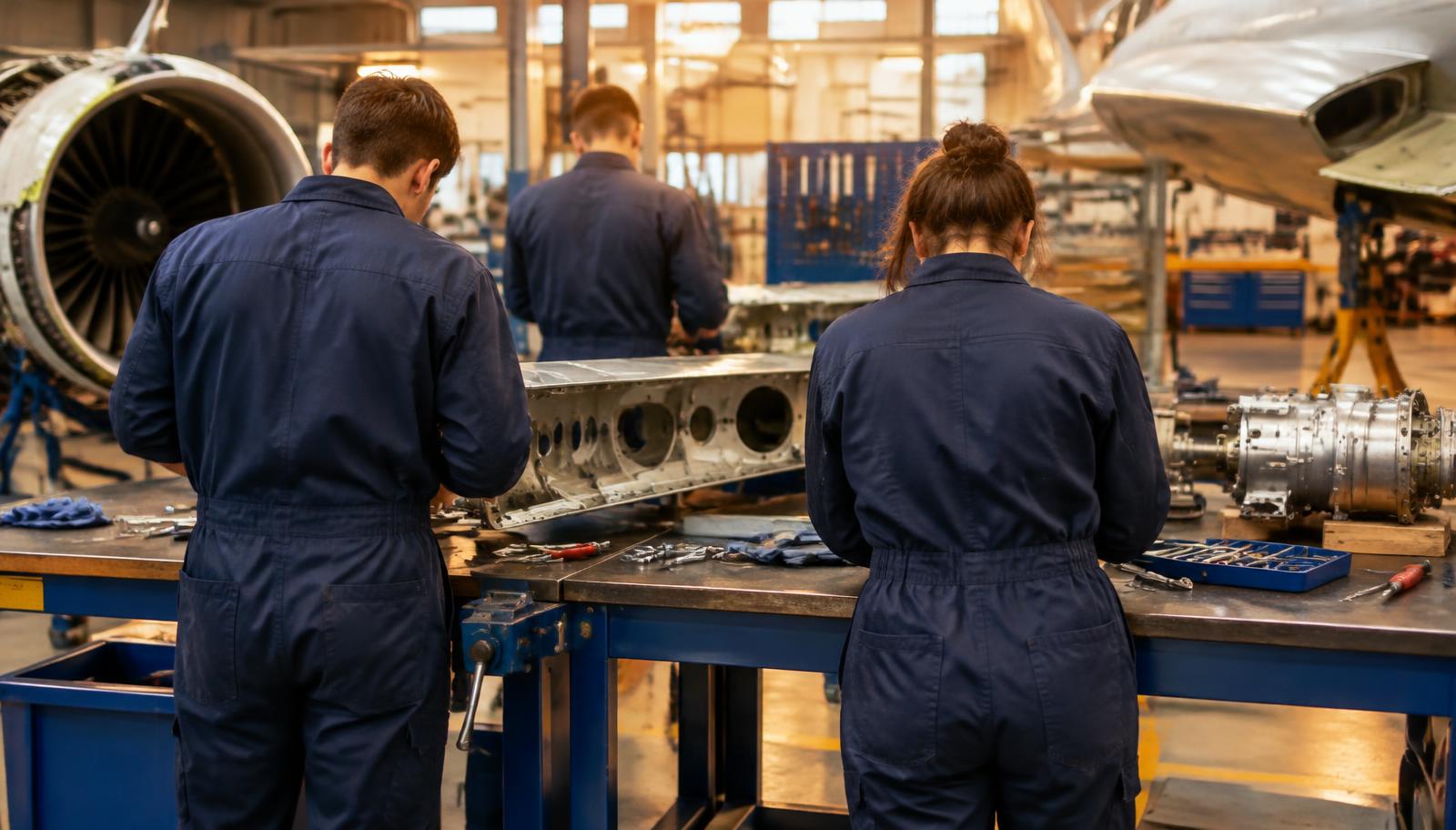
- production: fitters and assemblers, sheet-metal workers, CNC machinists, wiring technicians, composite operators;
- inspection and quality: inspectors, quality technicians, non-destructive testing specialists;
- maintenance: aircraft mechanics and technicians, avionics and structures;
- engineering: structural analysis, embedded systems, software, methods and industrialisation;
- support functions: procurement, supply chain, cybersecurity.
Skilled production jobs, often accessible through apprenticeship or continuing training, are where shortages are most acute. GIFAS has made work-study training and increasing the share of women in the industry two priorities, although its recent press releases do not publish numerical targets.
Levers being used
To meet these needs, the industry combines several approaches:
- partnerships with public employment and training bodies to steer jobseekers towards short qualifying courses;
- expansion of apprenticeship, from vocational baccalaureate to engineering degree;
- campaigns promoting careers to secondary school pupils;
- involvement in the campus des métiers et des qualifications dedicated to aeronautics and space;
- retraining of employees from other industrial sectors.
Maintenance, a parallel need
Needs are not limited to manufacturing. Maintenance shops, airlines and military operators also recruit qualified mechanics and technicians, in a market where the same profiles are sought by manufacturers. This competition between employers weighs on pay and retention, and pushes companies to invest more in in-house training and qualification pathways.
A long-term issue
The age pyramid, the ramp-up of civil programmes and rising defence requirements all point to demand for skills that should remain high. For candidates, the industry offers varied career paths and prospects for progression. For companies, the ability to attract, train and retain staff is becoming a competitive factor on a par with technology or cost.
Sources
Related articles
Campus des métiers et des qualifications: France's regional networks for aerospace training
Secondary schools, apprentice centres, universities, companies and regions: France's campus des métiers et des qualifications bring together a territory's training players around one industry. Seven are dedicated to aeronautics and space.
Apprenticeship in aerospace: contract rules and employer aid in France
A preferred route for training mechanics, technicians and engineers, apprenticeship follows a precise legal framework. Hiring aid has been revised several times since 2025: an overview of the current rules for manufacturers and maintenance shops.
Aerospace engineering schools: a French landscape of public grandes écoles and private institutions
ISAE-SUPAERO, ENAC, IPSA and others: France has a dense network of engineering programmes dedicated to aeronautics and space. Understanding their status, entry routes and the role of the CTI helps candidates and recruiters find their way.