From vocational baccalaureate to BTS in aeronautics: France's technical routes into maintenance and production
Before engineering school, the aerospace industry recruits technicians on a large scale. The aeronautics vocational baccalaureate and the BTS in aeronautics are the two pillars of this technical training, both in school and through apprenticeship.
By Newsroom · Published
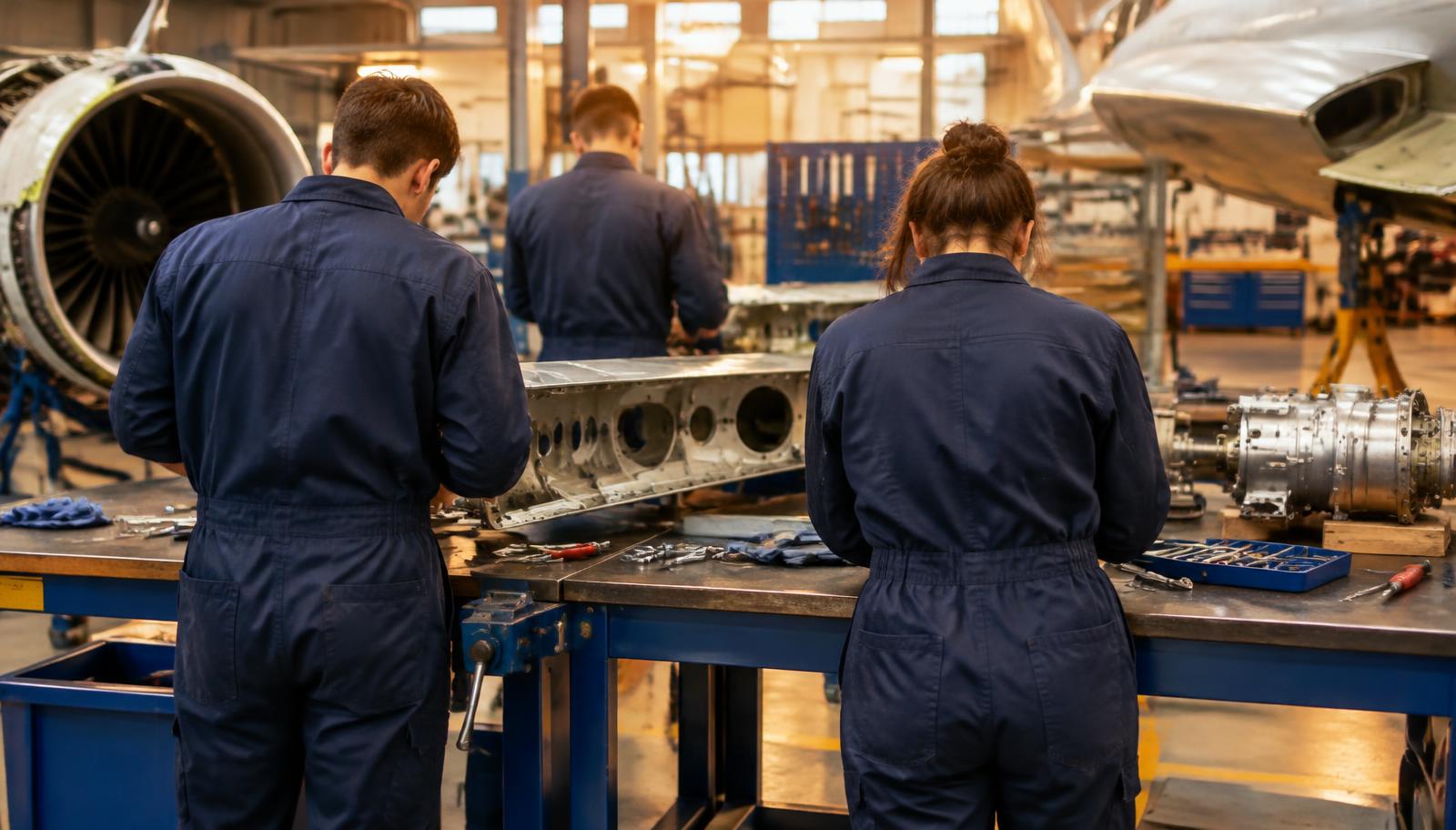
Technicians at the heart of the industry
Much of the aerospace industry's recruitment need concerns technical profiles: mechanics, fitters, wiring technicians, avionics or structures technicians and inspectors. These jobs exist at manufacturers and equipment suppliers as well as in maintenance shops, airlines and the armed forces. Two French national education qualifications structure access to them: the vocational baccalaureate in aeronautics (bac pro) and the BTS in aeronautics, a two-year higher technician diploma.
The bac pro in aeronautics: three options
The vocational baccalaureate in aeronautics takes three years after lower secondary school, or two years for pupils coming from a first-year vocational class or holding a CAP in the same aeronautics speciality. It comes in three options:
- avionics, focused on on-board electrical and electronic systems;
- systems, oriented towards engines and mechanical, hydraulic and pneumatic systems;
- structure, dedicated to the airframe and metallic and composite materials.
According to Onisep, the national careers information body, the work placement period is compulsory for the exam and lasts 20 weeks, spread over the three years for pupils in school. The qualification can also be prepared through apprenticeship.
Career outlets are broad: manufacturers, airlines, maintenance shops, technical service companies, subcontractors and equipment suppliers, as well as public services such as defence or civil protection.
The BTS in aeronautics: higher technician level
The BTS in aeronautics takes two years, in a secondary school or an apprentice training centre. It trains technicians able to manufacture, assemble or maintain aircraft and their equipment, with skills in quality, production organisation and maintenance. Students who are not apprentices complete a work placement of 8 to 12 weeks.
Entry is mainly after a technological (STI2D), general or aeronautics vocational baccalaureate, on the basis of an application file, sometimes with tests or an interview. Graduates work in aircraft or equipment production, or in maintenance, and can move on to engine makers, equipment suppliers or design offices.
The BTS is above all a qualification designed for entry into employment, but it is not a ceiling. Onisep lists several further study options: a professional bachelor's degree, a bachelor's in engineering sciences, parallel admission to engineering schools, an ATS preparatory class, or ENAC's airline pilot entrance exam.
School diploma and regulatory qualification
In civil maintenance, these diplomas fit alongside the European regulatory framework. The job of a technician authorised to release an aircraft to service relies on a maintenance licence issued under its own knowledge and experience requirements. Many institutions therefore combine the national education diploma with modules recognised within that framework, which speeds up access to responsibility in the shop. Candidates should check, institution by institution, exactly what the course covers.
The qualities employers look for
Beyond technical knowledge, employers stress qualities specific to the sector: rigour, strict adherence to procedures, a sense of traceability and the ability to work in a team. In a maintenance shop as on an assembly line, every operation is documented and checked. Command of technical English, the language of aviation documentation, is also a major asset.
Progressive pathways
The strength of these routes lies in their progression. A young person can start with a CAP or a bac pro, specialise with a BTS, then continue to a professional bachelor's degree or engineering school, often through work-study. The campus des métiers et des qualifications dedicated to aeronautics focus precisely on making these bridges easy to understand.
For companies, these qualifications are the main pool of technicians. Taking on interns and apprentices from bac pro level onwards remains one of the most effective ways of securing recruitment in shortage occupations.
Sources
Related articles
Campus des métiers et des qualifications: France's regional networks for aerospace training
Secondary schools, apprentice centres, universities, companies and regions: France's campus des métiers et des qualifications bring together a territory's training players around one industry. Seven are dedicated to aeronautics and space.
Recruitment: the French aerospace industry faces a lasting skills need
With 29,000 hires in 2024 according to GIFAS and more than 230,000 direct jobs, the aerospace industry remains one of France's largest industrial recruiters. Beyond the headline volumes, skills and the supply chain dominate the agenda.
Apprenticeship in aerospace: contract rules and employer aid in France
A preferred route for training mechanics, technicians and engineers, apprenticeship follows a precise legal framework. Hiring aid has been revised several times since 2025: an overview of the current rules for manufacturers and maintenance shops.